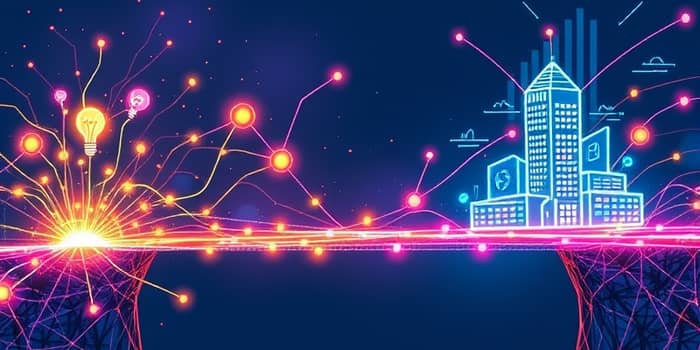
At the heart of the blockchain revolution stands an often-overlooked hero: the oracle. These specialized systems deliver the crucial link that empowers smart contracts to interact with real-world events. Without oracles, decentralized finance would remain isolated from the dynamic external data streams that fuel lending, trading, and automated settlements.
By uniquely bridging on-chain and off-chain worlds, oracles unlock a new dimension of trustless innovation. They transform static code into responsive, adaptive agreements capable of responding to fluctuating market prices, exchange rates, and external triggers.
Historical Context and Evolution
The concept of an oracle is not new. In classical terms, an oracle provided answers about future events. In blockchain, it serves a digital prophecy: enabling code to react to realities outside the network. As DeFi surged from niche experiments to multi-trillion-dollar ecosystems, the demand for reliable off-chain inputs accelerated.
Early finance blockchains relied on centralized feeds, but these soon revealed a fatal flaw: a single point of failure in practice. A single compromised data source could manipulate entire markets. The rise of decentralized alternatives introduced consensus, aggregation, and incentives to reinforce integrity.
Core Functionality of Oracles
Oracles operate through three main stages: sourcing, verification, and transmission. They collect raw data from external APIs or exchanges, run authenticity checks via multiple nodes, and then deliver verified inputs to smart contracts.
This process is supported by decentralized node networks fetching from exchanges and enabled by cryptographic proofs. Nodes compete to provide accurate data, while staking and penalty mechanisms discourage malicious behavior.
Vital Use Cases in DeFi
Oracles underpin a wide range of DeFi services, from simple lending platforms to complex synthetic asset protocols. Their impact can be seen across:
- Automated market makers and lending protocols, which adjust rates based on live price feeds
- Stablecoin systems, maintaining pegs to fiat currencies through constant rebalancing
- Derivatives platforms, settling contracts when underlying asset prices reach predetermined thresholds
- Liquidation engines, executing open positions when collateral values slip below safe levels
With these capabilities, DeFi protocols achieve automated market makers and lending protocols that respond instantly to global market shifts.
Types and Taxonomy of Oracles
Not all oracles are created equal. Solutions vary by governance, data flow direction, trust model, and specialization.
- Centralized oracles: Single entities delivering data quickly but risking control concentration.
- Decentralized oracles: Multiple nodes reaching consensus, enhancing resilience and censorship resistance.
- Inbound vs. outbound oracles: Inbound brings data on-chain, while outbound triggers real-world actions from smart contract outcomes.
Specialized platforms focus on price feeds or identity verification, while generalist pools aggregate diverse data sets. Trust is established through node staking, reputation systems, and cryptographic proofs.
Risks, Challenges, and Attack Vectors
Even the most robust oracle networks face challenges. Resistant to manipulation via authenticity proofs only holds if economic incentives align. Dominant providers can inadvertently centralize security, creating attractive targets for attackers.
Common vulnerabilities include data spoofing, governance concentration, and latency exploits. Addressing these risks requires layered defenses, continuous auditing, and active community governance.
Practical Guidance for Developers and Users
To harness oracles effectively:
- Choose decentralized oracle networks with multiple independent nodes to avoid single points of failure.
- Incorporate redundancy by querying several oracle providers and aggregating results.
- Implement delay allowances to detect and respond to anomalous data spikes.
- Engage in governance processes to influence oracle parameter settings and security audits.
Following these best practices ensures verifiable off-chain computation for sensitive data and builds robust DeFi applications.
Governance and Future Potential
Governance models range from token-based DAOs to centralized administrative councils. Approximately two-thirds of oracle platforms now employ token holder governance in a decentralized model, fostering community alignment and transparent decision-making.
Looking ahead, oracles will enable seamless integration of AI, IoT, and privacy-preserving data feeds. We can anticipate:
These advancements will expand DeFi into new industries, including supply chain finance, tokenized real-world assets, and decentralized identity systems. By embedding regulatory compliance and advanced analytics directly into smart contracts, oracles pave the way for mainstream institutional adoption.
Conclusion
Oracles are the unsung champions of decentralized finance. They inject smart contracts with the vital lifeblood of real-world data, transforming static code into dynamic, self-executing agreements. By choosing resilient oracle networks, incorporating redundancy, and actively participating in governance, developers and users can build DeFi platforms that stand the test of time.
As blockchain ecosystems evolve, oracles will continue to unlock new possibilities—bridging the gap between digital promises and physical realities. Embrace these innovations, stay vigilant against risks, and collaborate on governance to ensure a secure, equitable, and thriving DeFi future.
References
- https://stellar.org/learn/smart-contract-basics-oracles
- https://jnf.ufm.edu/cgi/viewcontent.cgi?article=1016&context=journal
- https://chain.link/education/blockchain-oracles
- https://www.wilsoncenter.org/article/delphi-defi-how-crypto-oracles-are-shaping-future-finance
- https://exponential.fi/blog/how-defi-oracles-work
- https://www.trmlabs.com/glossary/decentralized-finance
- https://pmc.ncbi.nlm.nih.gov/articles/PMC9857405/
- https://hedera.com/learning/what-is-decentralized-finance/