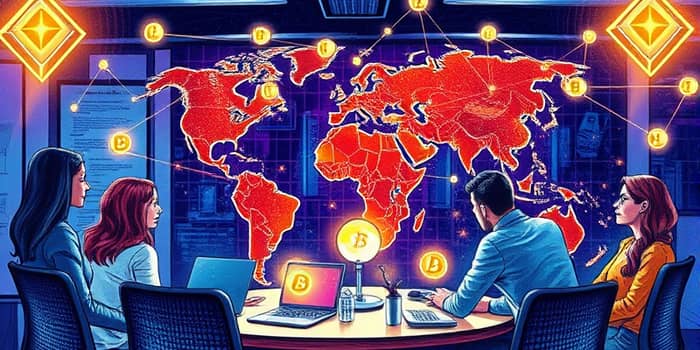
Decentralized Autonomous Organizations (DAOs) are revolutionizing how people collaborate, govern, and get compensated. As we step into an era shaped by blockchain and AI, DAOs stand at the forefront of the next work paradigm.
Core Definition and Concept of DAOs
DAOs are blockchain-based entities governed by smart contracts. They eliminate central authorities, enabling participants to propose, vote on, and execute tasks in a transparent ecosystem.
In simple terms, DAOs function as algorithm-run companies democratizing tasks where every financial transaction is verifiable on-chain. Contributors earn rewards automatically when predefined conditions are met.
This model fosters a flat hierarchy, boosting engagement by granting each member a voice proportional to their governance tokens. Participants collaborate across continents without intermediaries.
Historical Context and Evolution in Work
The DAO concept emerged from internet communities and accelerated remote work trends during global lockdowns. By removing physical offices, organizations witnessed global flexibility and reduced overhead.
Traditional companies began embracing distributed teams, but DAOs took decentralization further by rooting governance in code. This shift created new avenues for fair output-based compensation.
Advances in AI and blockchain intensified this transformation. Automated payments tied to smart contracts enable a workforce liberated from manual invoicing and delayed payroll.
Industry projections for 2026 forecast DAOs as integral to the "next generation of work," seamlessly intertwined with AI for governance, task verification, and payments.
Leading DAOs Shaping the Industry
Several DAOs have already demonstrated real-world impact, offering daily-use products and lucrative opportunities for contributors:
- Uniswap: A decentralized exchange protocol redefining liquidity.
- MakerDAO: Powers the DAI stablecoin via Maker Improvement Proposals with transparent governance cycles.
- Curve DAO: Focuses on stablecoin liquidity pools with clear task-based incentives.
- SushiSwap: A community-driven DeFi platform offering yield farming and governance rights.
- Bankless DAO: Offers media and educational resources on DeFi adoption.
- Friends With Benefits: A social DAO blending culture and blockchain rewards.
- Ethereum Name Service (ENS): Provides decentralized domain registration.
These organizations showcase how decentralized governance and automated compensation can work at scale, offering contributors both autonomy and accountability.
Advantages Over Traditional Companies
DAOs provide a host of benefits that challenge conventional corporate structures:
- Choice and Autonomy: Contributors pick tasks matching their passions, with no penalty for non-participation.
- Transparency: Financial ledgers, budgets, and voting records are public and immutable.
- Global Reach: Members collaborate anonymously or pseudonymously across time zones.
- Fair Compensation: Automated release of funds upon task completion aligns rewards with output.
- Democratic Governance: Token holders vote on proposals, amplifying engagement and ownership.
By enabling transparent voting and payment processes, DAOs eliminate many overheads associated with managerial hierarchies.
Emerging Roles and the 2026 Job Landscape
As DAOs proliferate, new roles are emerging that blend technical, strategic, and community skills. Early adopters gain strategic talent advantages.
Additional blockchain-adjacent roles are expanding into DAOs, including project managers, security specialists for smart contract auditing, and business analysts skilled in decentralized metrics.
Broader Executive Integration and Blockchain Hiring
By 2026, hybrid C-suite roles centered on blockchain will become mainstream. Organizations will seek leadership fluent in decentralized operations.
Positions like Chief Blockchain Officer and VP of Decentralized Operations will drive enterprise-wide adoption of DAO principles. Responsibilities will encompass aligning token strategies with business goals.
Heads of Web3 Product Development will manage tokenized offerings, while Chief Compliance Officers will ensure global regulatory compatibility.
These roles underscore the transition toward a flat hierarchy free from bureaucracy and borderless cultures bolstered by token-based governance.
Challenges and Disadvantages
Despite their promise, DAOs face hurdles:
Governance can be slow when proposals require extensive discussion. Consensus-building without clear leadership may lead to stalemates or fragmented decision-making.
Security risks are inherent in smart contracts. Vulnerabilities have historically led to fund losses, highlighting the need for rigorous audits.
Maintaining passion alignment across a diverse, distributed workforce can be difficult. Cross-time zone coordination may introduce inefficiencies.
Even so, many believe these challenges are solvable through improved tooling, governance frameworks, and educational initiatives.
Intersections with AI and Future Trends
At Davos 2026, experts described scenarios where AI amplifies human capability. DAOs fit naturally into this ecosystem by offering automated, transparent task verification.
AI-driven payments could lead to a Paid by AI culture, where contributions are measured and rewarded instantly. This parallels AI’s 27% wage increase in digital skills since 2019.
Future scenarios include a co-pilot economy, where decentralized teams use AI to augment expertise, and guardrails ensure no worker is displaced without reskilling support.
DAO frameworks can serve as buffers in the so-called age of displacement, providing community-driven safety nets and reskilling bounties.
Platforms, Skills, and Future Outlook
Entry into DAO work is facilitated by platforms like Crypto Jobs List and blockchainstaffingninja.com, which host both bounty-based tasks and full-time roles.
- Essential skills include blockchain fundamentals, smart contract literacy, and governance token mechanics.
- Cross-functional strategy, remote collaboration, and community engagement are increasingly valuable.
- Continuous reskilling in AI tools and decentralized finance protocols will be crucial.
Looking ahead, DAOs are poised to become the backbone of a decentralized workforce. By combining transparent governance, automated payments, and global collaboration, they reflect the ethos of platform economies discussed at the World Economic Forum.
As organizations experiment with token incentives and smart contract workflows, contributors gain unprecedented control over their work lives and earnings.
Ultimately, DAOs promise a future where individuals collaborate across borders with trust embedded in code, unlocking new levels of innovation and inclusivity.
References
- https://cryptojobslist.com/blog/dao-jobs-future
- https://www.blockchainstaffingninja.com/future-blockchain-roles-hiring/
- https://www.cimco.tech/2026030321656-3847799.shtml
- https://www.weforum.org/stories/2026/01/davos-here-s-what-to-know-about-jobs-and-skills-transformation/
- https://www.youtube.com/watch?v=qf34_4qhrzI