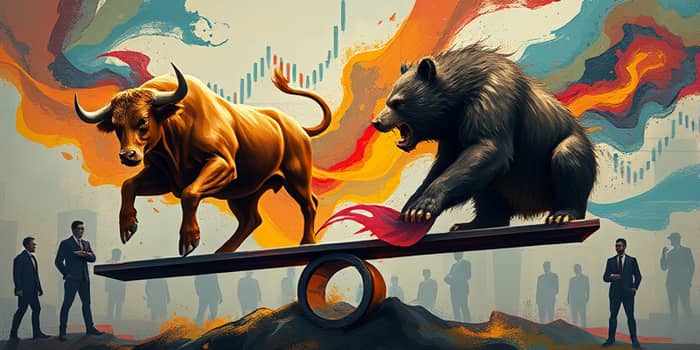
Financial markets are not only driven by fundamentals but also by the complex emotions of participants. Investors’ decisions are shaped by deep-seated biases, memories of past events, and shifting sentiment. In this article, we explore how bulls and bears influence behavior and how awareness can transform decision-making.
By examining key patterns—overconfidence in rising markets, panic in declining ones, and the tug-of-war between fear and greed—we will uncover strategies to build resilience and capitalize on opportunities. Self-awareness and disciplined risk management can turn psychological challenges into strategic advantages.
Riding the Emotional Rollercoaster
Bull markets foster optimism, with participants feeling invincible as prices climb. Yet this exuberance breeds overestimate their own trading skills, and many fall prey to leverage and moral hazard. Central bank bailouts and quantitative easing create a false sense of permanent market support, encouraging risky bets.
Conversely, bear markets ignite fear, prompting sharp sell-offs and defensive postures. The average historical bear drawdown of 30–50% can leave investors shaken, and those without experience often suffer from an empty memory bank of past downturns, underestimating pain and overestimating safety.
“Bull market genius is not just overconfidence. It’s mistaking a rising tide for your own intelligence.”
Fear and Greed: The Twin Engines
Fear and greed are the primary engines driving market swings. Greed fuels speculative bubbles during booms, while fear triggers panic sales in busts. Understanding their interplay helps anticipate inflection points.
- In bull markets, greed leads to preferring to avoid all potential losses—often eclipsing fundamental analysis.
- In bear markets, fear dominates, causing investors to sell indiscriminately and miss rebounds.
- Herd mentality amplifies both phases, as crowds chase momentum or flee en masse.
Key Biases Shaping Investor Behavior
Behavioral finance highlights biases that challenge the Efficient Market Hypothesis. Emotions and heuristics create persistent inefficiencies, enabling anomalies like bubbles and crashes. Below is a comparative overview:
Stages of Bear Markets
Bear markets typically unfold in three phases: an initial sharp fall, a reflexive rebound driven by short covering, and a prolonged grind lower as pessimism deepens. Each stage tests different aspects of investor psychology.
“Bear markets have 3 stages: A sharp fall often followed by a reflexive rebound, and then a long, drawn-out downtrend.”
During the first phase, panic selling can create steep losses. The rebound phase often lures in sidelined traders, only for the final stage to erode confidence over months or years.
Navigating the Emotional Waters
Developing emotional resilience is crucial. By anticipating biases, investors can set rules to manage risk and seize opportunities rather than succumb to herd impulses or paralysis.
- Establish clear stop-loss and profit-taking rules before markets turn.
- Maintain diversified cash reserves to capitalize on market dislocations.
- Limit leverage and avoid speculative positions during extended rallies.
- Study historical cycles to counteract recency bias.
Lessons from History
The 2007–08 global financial crisis exemplifies herd fear and moral hazard. Bailouts and zero-rate policies over the past 15 years entrenched a buy-the-dip mentality, while the swift COVID-19 rally spurred meme stock bubbles—illustrating how mistaking luck for genuine investment acumen can distort decision-making.
Demographics also shape reactions: investors under 30, never having experienced prolonged bear markets, often misjudge risk. Surveys show 90% of participants were confident in bull market continuation, yet only 50% would re-enter after a crash—highlighting the gap between expectation and action.
“Stocks resemble savings accounts, volatility appears as opportunity, and risk appears as a relic.”
Looking Beyond the Noise
Behavioral economics demonstrates that emotions and heuristics steer markets away from pure efficiency. Professional investors with psychological training can leverage these insights, spotting irrational excesses that signal buying or selling opportunities.
“Investors are often driven by emotions like fear and greed, which can lead to market anomalies.”
Conclusion: Harnessing Emotions for Better Decisions
Understanding the psychological underpinnings of bull and bear markets empowers investors to act with clarity and discipline. Rather than react impulsively, recognizing biases and emotional triggers allows for strategic positioning, robust risk management, and the potential to thrive across market cycles.
By internalizing the lessons of past crises, establishing guardrails, and nurturing self-awareness, every investor can transform emotional challenges into a sustainable edge—steering portfolios toward long-term success.
References
- https://realinvestmentadvice.com/resources/blog/bull-market-genius-is-a-dangerous-thing/
- https://ritholtz.com/2013/05/habits-of-the-bear-bull-markets-and-agency-issues/
- https://www.activtrades.com/en/news/psychology-breadth-bear-markets-trading-by-the-rules
- https://in.snhu.edu/blogs/understanding-psychology-of-financial-markets
- https://digitalcommons.buffalostate.edu/cgi/viewcontent.cgi?article=1026&context=economics_theses
- https://onlinelibrary.wiley.com/doi/pdf/10.1002/9781119209195.ch13
- https://journals.sagepub.com/doi/abs/10.1177/03128962231184659