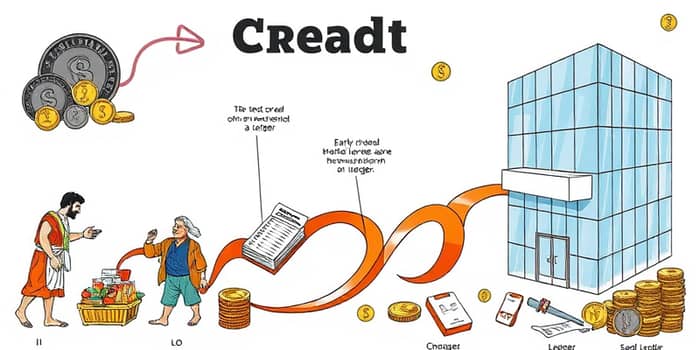
Credit is more than a modern convenience—it is a story of trust, innovation, and perseverance. From the earliest grains lent in ancient fields to the digital scores that shape our financial lives today, credit has continually transformed.
By understanding this journey, you can gain insight into crucial lessons for modern financial health and discover practical steps to strengthen your own credit profile.
From Barter to Early Lending
Long before coins or banknotes, communities exchanged goods through barter. Farmers traded grain for livestock, and artisans swapped pottery for metal. Gradually, the concept of lending emerged as a way to bridge gaps between harvests or production cycles.
In Mesopotamia around 2000 BCE, temples acted as de facto banks, offering loans of barley and silver. These loans were often secured by collateral or future labor. Such arrangements laid the groundwork for ancient civilizations engaged in lending and borrowing.
By the Middle Ages, local shopkeepers in Europe and America extended trust to regular customers. A ledger at the corner store might record groceries taken home, to be paid after payday. This informal system sowed the seeds for the retail credit models of the 19th century.
The Rise of Credit Bureaus
As commerce expanded in the 1800s, subjective assessments of trust became impractical. Lenders needed reliable, objective information. In 1841, Lewis Tappan founded the Mercantile Agency to collect business data and publish reports. When Robert Graham Dun acquired it, R.G. Dun & Company emerged as a pioneer in centralized credit reporting and analysis.
In 1857, Bradstreet introduced a more formal commercial credit rating, and by 1864, Dun perfected an alphanumeric system still used in principle today. Meanwhile, the Retail Credit Company—later Equifax—opened in Atlanta in 1899, providing merchants with consolidated consumer data.
By the end of the 19th century, hundreds of local bureaus existed, but the merger of major players created the framework for the nationwide systems we rely on today.
The Birth of the Modern Credit Score
In 1956, Bill Fair and Earl Isaac envisioned a fairer, data-driven approach. They founded Fair, Isaac and Company to develop an objective credit scoring system to lenders. Their first statistical model debuted in 1958, yet adoption was slow.
National retailers were among the earliest converts. By offering a consistent method to assess borrowers, they reduced bias and sped up approvals. The 1970 Fair Credit Reporting Act furthered transparency, mandating that reports exclude prejudicial biases in credit decisions and giving consumers the right to dispute errors.
When FICO introduced a universal score in 1989, it revolutionized lending. Suddenly, banks, auto financiers, and card issuers could rely on a single number rather than varied in-house metrics. This shift marked the true birth of the modern credit score as we know it.
From Metal Plates to Plastic Cards
The first charge “cards” were metal or celluloid tokens issued in the 1860s by merchants and oil companies. Farmers used them during westward expansion, repaying after harvest. In 1914, Western Union’s metal money added prestige to the concept.
Store chains issued Charga-Plates in the 1930s, but lack of interoperability limited their reach. True transformation arrived with the Diners Club card in 1950—the first card accepted by multiple merchants. In 1958, revolving credit became commonplace, ushering in the modern era of plastic.
BankAmericard (later Visa) and Master Charge (later Mastercard) rolled out in the late 1950s and 1960s, mailing unsolicited cards to millions. IBM’s invention of the magnetic stripe in 1969 added a layer of security, setting the stage for today’s digital and contactless payments.
Practical Lessons for Today’s Consumers
The evolution of credit teaches us that trust and data go hand in hand. By learning from history, you can take control of your financial future. Here are four actionable steps:
- Pay bills by due dates to avoid late fees and build a record of on-time payments.
- Keep credit utilization below 30% of your limits to maintain a strong score.
- Review your credit reports annually for errors and dispute any inaccuracies you find.
- Build credit history by responsibly managing diverse accounts, such as installment loans and credit cards.
Every era in credit’s history reflects a desire for fairness and efficiency. Today, technology offers tools to monitor scores in real time, set payment reminders, and simulate the impact of financial decisions.
By embracing these tools and respecting the timeless principles of honesty and diligence, you can shape a credit story of your own. Whether you’re just beginning your journey or rebuilding after setbacks, remember that credit is not static—it is a journey spanning thousands of years, and your actions today write the next chapter.
References
- https://www.rocketmoney.com/learn/debt-and-credit/the-history-of-credit
- https://www.provenir.com/when-were-credit-scores-invented/
- https://www.swipesum.com/insights/history-of-the-credit-card
- https://www.credit-bureau.com/history/
- https://www.experian.com/blogs/ask-experian/the-history-of-credit-cards/
- https://www.opploans.com/oppu/building-credit/a-brief-history-of-credit-scores/
- https://thepointsguy.com/credit-cards/history-of-credit-cards/
- https://www.nav.com/blog/history-of-business-credit-3688149/
- https://en.wikipedia.org/wiki/Credit_card
- https://time.com/3961676/history-credit-scores/
- https://www.paragonedge.com/blog/a-look-at-the-history-of-credit-cards-and-the-evolution-of-payments
- https://www.gocreditmatters.com/Credit%20Library/Credit%20Reporting%20and%20Scoring/How%20to%20Read%20a%20Credit%20Report/historyofcreditreports.html
- https://www.au.bank.in/blogs/history-and-invention-of-credit-cards
- https://en.wikipedia.org/wiki/Credit_score_in_the_United_States