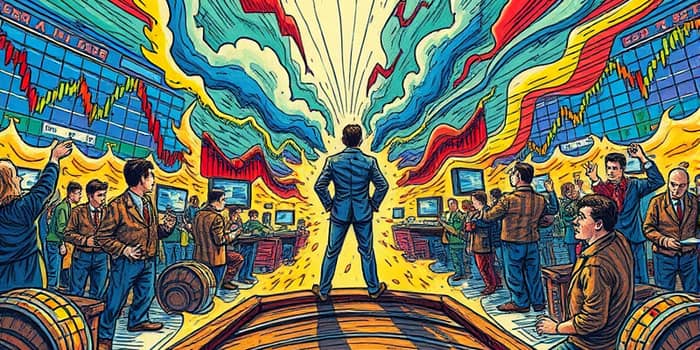
Contrarian investing is more than a strategy—it’s a mindset that empowers investors to rise above the tide of fear and greed that dominates financial markets. By deliberately purchasing undervalued assets when sentiment is bleak and trimming positions amid euphoria, contrarians seek to exploit the mispricings caused by behavioral biases. Far from being a reckless gamble, this disciplined approach rests on rigorous analysis and emotional fortitude.
Definition and Core Principles
At its heart, contrarian investing involves acting against prevailing market sentiment. Rather than chasing the crowd, contrarians identify opportunities where prices have diverged significantly from intrinsic value. They rely on three fundamental pillars:
- Long-term horizon: Extended timeframes allow investors to ride out volatility and realize potential gains.
- Focus on fundamentals: Emphasis on financial health, valuation metrics, and business models shields against speculative noise.
- Buy low, sell high: Systematic purchases in bear markets and disciplined exits during bull runs capture asymmetrical returns.
Contrarianism is not inherently bearish; instead, it zeroes in on specific mispriced opportunities rather than issuing blanket market forecasts. It demands independent research and a willingness to stand alone when markets diverge from rational assessments.
Historical Performance That Speaks Volumes
Empirical studies consistently demonstrate that contrarian strategies can outperform conventional approaches over long horizons. Markets often overreact to short-term news, creating windows where anxiety drives prices below fundamentals, only to rebound later.
The famous “Dogs of the Dow” strategy and John Maynard Keynes’s endowment management stand as proof that steadfast contrarian bets can yield extraordinary long-term results, even when they defy prevailing wisdom.
Iconic Contrarian Investors and Their Legacies
Some of history’s most renowned investors have embodied the contrarian ethos, translating contrarian insights into multi-decade successes:
Warren Buffett, often mischaracterized as purely a value investor, has repeatedly acquired distressed assets during market turmoil, banking on eventual recoveries. His patience and conviction illustrate the power of patient capital deployment.
Michael Burry’s prescient shorting of the U.S. housing market before the 2008 crash exemplifies the courage to act when evidence clashes with consensus. Despite facing investor redemption pressure, his approach yielded massive profits.
John Maynard Keynes, in the 1940s, allocated his college endowment heavily into stocks and international assets when peers preferred bonds and real estate. His contrarian stance delivered over 6% annual outperformance against the UK market average.
These figures, alongside systematic strategies like the Dogs of the Dow, underscore that contrarian investing is both an art of independent thinking and a replicable discipline.
Implementing Contrarian Strategies Today
Translating contrarian theory into practice requires a clear roadmap. Investors should consider the following tactics:
- High P/E vs. Low P/E rotation: Flip allocations between extreme valuation deciles each quarter or year.
- Portfolio balancing: Reallocate from overheated sectors into areas showing fundamental weakness but recovery potential.
- Long/short positions: Pair undervalued long bets with short positions in richly priced stocks to hedge market risk.
- Focus on asset classes often overlooked: emerging markets, distressed debt, and real estate during sector downturns.
- Adopt a systematic rebalance schedule, resisting emotional impulses to chase winners.
Consistent application of these tactics, underpinned by rigorous financial modeling, turns contrarianity into a disciplined process rather than a gut-driven hunch.
Risks, Rewards, and the Psychological Game
While the upside potential of contrarian investing is compelling, it carries inherent risks. Timing is paramount—assets can remain undervalued far longer than anticipated, testing an investor’s resolve. Moreover, contrarians may endure extended underperformance when popular stocks continue to rally.
Psychological resilience is therefore essential. One must cultivate emotional control against the crowd and embrace short-term discomfort for long-term gain. The approach also demands acceptance of higher volatility and, in the case of short positions, the specter of unlimited losses if fundamentals deteriorate further.
Who Should Consider Contrarian Investing?
Contrarian strategies suit investors who combine patience with deep analytical skill. Ideal candidates possess:
- Long investment horizons (five years or more).
- A high risk tolerance and willingness to tolerate drawdowns.
- Strong foundation in financial statement analysis.
- An independent temperament, unconstrained by market chatter.
Newcomers and short-term traders may find the approach too demanding, both intellectually and emotionally. Without a disciplined framework, the very traits that enable high returns can lead to missteps and frustration.
Looking Ahead: Contrarian Opportunities in 2026
With global markets exhibiting diverging trends, 2026 presents a fertile ground for contrarian ideas. Analysts at Morgan Stanley highlight sectors where consensus underweights potential, from industrial metals to emerging Asian equities. Morningstar, meanwhile, points to foreign stocks undervalued amid domestic U.S. bias.
Investors prepared to challenge the crowd may uncover asymmetric profit opportunities that elude traditional strategies. The key lies in rigorous research, balanced portfolios, and the courage to invest when headlines shout caution.
In an era of rapid information flow and market polarization, contrarian investing stands as a beacon for independent thinkers. By embracing a long-term horizon, focusing on fundamentals, and maintaining emotional discipline, investors can navigate volatility and capture rich rewards. The art of the contrarian is not merely about defying the crowd; it’s about seeing value where others see risk, and acting with conviction when it matters most.
References
- https://corporatefinanceinstitute.com/resources/career-map/sell-side/capital-markets/contrarian-investing/
- https://armgpublishing.com/journals/sec/volume-8-issue-2/article-3/
- https://en.wikipedia.org/wiki/Contrarian_investing
- https://www.quanloop.com/en/insights/how-effective-is-contrarian-investing-strategy/
- https://www.heygotrade.com/en/blog/what-is-contrarian-investing
- https://www.contrarian-investing.com
- https://www.morganstanley.com/insights/articles/contrarian-investing-views-shaping-markets-2026
- https://beckbode.com/blog/contrarian-investing-strategies
- https://indexes.morningstar.com/insights/perspective/blted4283e8b29955c8/3-contrarian-investment-ideas-for-2026
- https://www.crystalfunds.com/insights/contrarian-investing