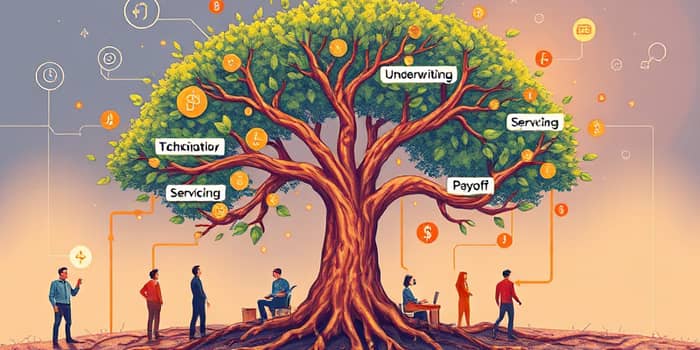
The journey of a loan, from the first spark of interest to the final payoff, is more than a series of transactions—it is a partnership between borrower and lender that can transform lives and businesses. Understanding each stage of this process empowers both institutions and individuals to navigate the path with confidence, clarity, and purpose.
The Beginning: Origination Phase
Every great journey starts with a single step. In the loan lifecycle, that step is pre-qualification and lead sourcing, where prospective borrowers learn whether they fit basic eligibility criteria. This phase lays the foundation for trust, using soft credit pulls or self-reported data to avoid unnecessary inquiries on credit reports.
Once interest is confirmed, the borrower moves to the application submission stage. Here, digital forms and guided portals collect comprehensive personal and financial information. By streamlining data entry, lenders can reduce friction and minimize incomplete applications.
- Inquiry & Pre-Qualification: Assess basic eligibility
- Application Submission: Gather borrower details
- Verification & Documentation: Confirm identity and income
Underwriting and Approval: The Crucial Assessment
Underwriting is often viewed as a hurdle, but it is, in fact, an opportunity to ensure a healthy, sustainable relationship. During underwriting and risk assessment, lenders analyze credit bureau data, income statements, and alternative metrics powered by AI/ML models to gauge creditworthiness. This analysis determines the loan terms—interest rate, amount, and any collateral requirements.
Key factors in this stage include:
- Credit score and payment history
- Debt-to-income ratio analysis
- Collateral appraisal when applicable
After the risk assessment, the lender issues an approval or denial. A clear, transparent decisioning process not only speeds up funding but also fosters borrower trust and satisfaction.
The Journey Continues: Servicing and Support
Once the loan is funded, the real work begins. Ensuring seamless borrower experience during the servicing phase is critical. Borrowers make scheduled payments, interact with support teams, and manage their accounts through online portals or mobile apps.
Effective servicing includes:
- Automated billing and payment reminders
- Delinquency alerts and resolution workflows
- Dedicated customer support channels
A lender’s responsiveness, measured by metrics like rapid response rate and first contact resolution, can make the difference between a loyal customer and one who never returns.
Empowering Through Data: Metrics and KPIs
Data-driven insights shape continuous improvement. Tracking comprehensive performance and satisfaction metrics ensures that every phase of the loan lifecycle remains optimized. Key performance indicators include:
By analyzing these metrics, lenders can identify bottlenecks, adjust policies, and enhance both speed and quality of service.
Harnessing Technology: Tools and Automation
Modern lending thrives on intelligent automation and digital tools. From chatbot-powered support to AI-driven underwriting, technology accelerates processes and reduces human error.
Best practices include:
- Integrating document verification platforms for instant checks
- Deploying AI models to predict default risk with high accuracy
- Implementing self-service portals where borrowers manage payments and view statements
These innovations not only cut down operational costs but also deliver significantly improved turnaround times—sometimes from days to mere minutes.
Bringing It All Together: From Payoff to Satisfaction
The final chapter in the loan lifecycle is payoff, where the borrower completes repayment in full, refinances, or, in unfortunate cases, faces default resolution. This stage measures whether the initial promise—mutual benefit and satisfaction—has been fulfilled.
Successful payoff strategies include offering refinancing options, clear payoff statements, and proactive communication as the loan nears maturity. Celebrating this milestone with borrowers, perhaps through a personalized congratulation message, reinforces loyalty and encourages repeat business.
Strategies for Continuous Improvement
The loan lifecycle is dynamic. Markets shift, technologies evolve, and borrower expectations rise. Lenders who adopt a culture of continuous improvement remain at the forefront. Key steps are:
- Regularly reviewing KPIs and customer feedback
- Conducting cross-functional workshops to streamline processes
- Piloting emerging technologies and measuring impact
By embracing agility, institutions can anticipate challenges, adapt quickly, and always keep the borrower’s experience at the heart of their strategy.
In essence, the loan lifecycle is not a static sequence but a living, breathing journey. When lenders and borrowers collaborate with transparency, backed by robust data and innovative tools, the process transforms from a mere transaction into a powerful catalyst for growth and opportunity. Empowered by this comprehensive framework, every stakeholder can look forward to a future defined by trust, efficiency, and lasting satisfaction.
References
- https://www.partake-fintech.com/the-loan-lifecycle-process-explained/
- https://southstatecorrespondent.com/banker-to-banker/customer-experience-how-service-focused-banks-measure-their-performance/
- https://bepeerless.co/blog/lending-lifecycle-stages-and-tools-every-fintech-should-know/
- https://capacity.com/digital-transformation/digital-transformation-further-reading/what-metrics-mortgage-lenders-should-use-to-measure-customer-experience-success/
- https://www.canopyservicing.com/blog/loan-life-cycle/
- https://ailleron.com/insights/how-to-measure-customer-satisfaction/
- https://finezza.in/blog/optimising-the-loan-origination-lifecycle/
- https://www.coconutsoftware.com/blog/how-to-track-csat-benchmarks-in-banking-a-guide/
- https://nortridge.com/blog/loan-processing-workflow/
- https://www.moxo.com/blog/customer-satisfaction-metrics
- https://www.blooma.ai/blog/the-4-stages-of-the-loan-origination-process
- https://www.lightico.com/blog/lending-kpis-most-important/
- https://loanpro.io/glossary/loan-lifecycle-management
- https://hl.com/client-satisfaction/beyond-the-numbers/
- https://www.tatacapital.com/blog/capital-goods-loan/understanding-the-loan-life-cycle-a-comprehensive-guide/