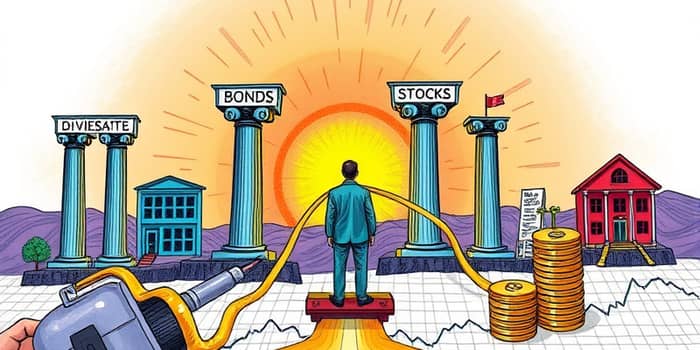
In an age of market uncertainty and fluctuating rates, generating reliable income from investments has become both an art and a science.
By focusing on sustainable payouts rather than chasing short-term gains, income-focused investors can build portfolios that weather economic storms and deliver consistent cash flow for decades.
Understanding Income Investing in Today's Market
After years of ultra-low rates, the landscape has shifted. With the Federal Reserve poised to begin rate cuts throughout 2026, yields on bonds and savings accounts have normalized, creating fresh opportunities for yield seekers.
Nevertheless, inflation remains persistent, credit spreads are tight, and equity valuations sit near historic highs. Navigating these headwinds requires both discipline and creativity.
- Persistent inflation affecting real yields
- Tight credit spreads limiting bond attractiveness
- Elevated equity valuations increasing downside risk
- Geopolitical and policy uncertainty shaping markets
Fixed Income Opportunities
Bonds still serve as the backbone of many income portfolios, but the key is finding the right segment. Intermediate maturities, between five and ten years, offer a blend of yield and capital appreciation potential.
In this environment, investors may find attractive prospects in sectors that balance credit quality with yield enhancement.
- Investment-grade corporate bonds yielding over 70 basis points above Treasuries
- High-yield credit offering approximately 6.7% returns
- Emerging-market sovereign debt with yields surpassing 6%
- Collateralized loan obligations providing floating-rate protection
- Municipal bonds delivering tax-advantaged income streams
Equity Income Strategies
Dividend-paying stocks bring the dual benefit of income and potential growth. By selecting companies with strong cash flows and reliable payout histories, investors can build a portfolio that yields sustainably over time.
Geographic diversification further enhances yield opportunities. For example, UK equities currently offer 4%–4.5% yields while Brazilian stocks deliver closer to 5%–5.5%, with the added incentive of emerging market upside.
Specialized equity vehicles, such as real estate investment trusts (REITs), mortgage REITs, and preferred securities, can complement traditional dividend stocks by providing differentiated streams of regular payouts.
Alternative Income Sources
Beyond bonds and equities, investors can explore nontraditional avenues that enhance overall yield without excessive risk.
- Business Development Companies offering private credit-style yield generation
- High-yield savings accounts for liquid, low-risk income
- Currency-hedged international bond funds for diversification
These alternatives can act as stabilizers within a broader income framework, balancing exposure to market cycles and interest rate shifts.
Strategic Diversification Principles
In 2026, a dynamic multi-asset income strategy will likely outperform portfolios concentrated in a single asset class. By layering sources of yield—fixed income, dividend equities, and alternative vehicles—investors can capture returns in varied market environments.
Key diversification steps include:
– Balancing maturities to manage duration risk and rate sensitivity.
– Allocating across sectors such as healthcare, global infrastructure, and select emerging markets for defense and growth potential.
– Employing currency hedging where appropriate to mitigate foreign exchange volatility.
Common Pitfalls to Avoid
Even seasoned investors can stumble when chasing yields without evaluating underlying risks. Two of the most common missteps include:
Chasing the highest yields without due diligence. High returns often carry hidden risks in credit quality or liquidity.
Neglecting inflation’s impact on real income. Nominal yields may look appealing but can be eroded by rising consumer prices.
Avoiding these traps means staying disciplined, monitoring valuations, and rebalancing portfolios as market conditions evolve.
Conclusion: Building a Resilient Income Portfolio
Successful income investing in 2026 involves more than selecting the highest-yielding instruments. It demands ongoing assessment of economic trends, credit fundamentals, and valuation metrics.
By adopting a balanced, forward-looking allocation approach, investors can engineer portfolios that not only deliver steady streams of dependable income but also preserve capital through market cycles.
Whether you are planning retirement distributions or simply seeking additional cash flow, a thoughtful, diversified income strategy can provide both peace of mind and financial resilience.
References
- https://thesmartinvestor.com.sg/3-reit-mistakes-income-investors-should-avoid-in-2026/
- https://www.etftrends.com/etf-investing-content-hub/active-solution-blue-chip-growth-2026/
- https://www.morningstar.com/financial-advisors/income-investing-strategies-2026-maximizing-yield-an-uncertain-market
- https://www.blackrock.com/us/financial-professionals/insights/2026-income-outlook
- https://www.nerdwallet.com/investing/learn/what-is-passive-income-and-how-do-i-earn-it
- https://www.vaneck.com/us/en/blogs/income-investing/income-investing-playbook/
- https://www.pimco.com/us/en/insights/charting-the-year-ahead-investment-ideas-for-2026
- https://www.wellington.com/en-us/institutional/insights/top-5-fixed-income-ideas-for-2026
- https://www.youtube.com/watch?v=WhQCEJ9jmY0
- https://www.bankrate.com/investing/best-investments/