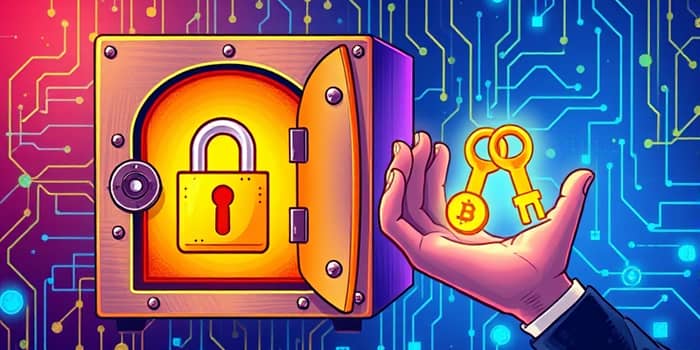
In an era where digital assets hold immense value, knowing how to store them safely is paramount. From major exchange hacks to rising self-custody adoption, the choice between third-party management and personal control has never been more critical.
Your decision affects both your security and your freedom. Embrace the path that aligns with your comfort, goals, and risk tolerance, guided by the your keys, your coins philosophy.
Understanding the Basics of Wallet Custody
Cryptocurrency wallets fall into two categories: custodial and non-custodial. In a custodial model, a service provider holds your private keys and manages transactions on your behalf. This approach prioritizes convenience and built-in support, often at the expense of control and privacy.
Conversely, non-custodial wallets hand you the reins. You generate and safeguard your private keys and seed phrases. This model embodies full control over private keys and fosters direct interaction with the blockchain.
Comparing Core Features
Assessing key characteristics helps clarify which wallet type aligns with your needs. Below is a side-by-side overview of the most critical features.
Pros and Cons of Custodial Wallets
Custodial services appeal to newcomers and institutions seeking streamlined access and support. However, relying on a third party introduces unique risks.
- Ease of use with integrated recovery options
- Professional security measures and insurance coverage
- Dedicated customer support for troubleshooting
- Potential for withdrawal limits, freezes, or delays
- Exposure to exchange hacks and regulatory action
- Loss of autonomy and dependency on provider health
Embracing Non-Custodial Wallets
Non-custodial wallets empower individuals to take full custody of their digital wealth. By eliminating intermediaries, you safeguard against centralized failures and develop a deeper understanding of blockchain mechanics.
With this model, you accept the responsibility to secure your keys and seed phrase. Tools like hardware devices, multi-party computation (MPC), and social recovery schemes offer robust methods to protect assets while preserving independence.
Yet, the freedom comes with challenges: the seed phrase backup risks loom large, and any mistake can mean irreversible loss. A deliberate approach to key management and regular security audits can mitigate these dangers.
Historical Context and Real-World Risks
High-profile breaches—such as the $90 million Liquid exchange hack—underscore the vulnerabilities inherent in custodial custody. Institutional collapses, from Mt. Gox to Celsius, highlight how funds held in custody can vanish through insolvency or mismanagement.
These events catalyzed a self-custody movement among users prioritizing sovereignty over convenience. As decentralized finance (DeFi) platforms emerged, the appeal of direct blockchain interaction grew stronger.
Technical Deep Dive: Keys, Seeds, and Storage
At the heart of every wallet lies the private key—an alphanumeric code granting access to your assets. Custodial providers store these keys securely on your behalf, while non-custodial solutions delegate key generation and storage to you.
Seed phrases, comprising 12 to 24 words, serve as human-readable backups. Anyone possessing this phrase can reconstruct your private keys. Employing hardware wallets keeps your keys offline, shielding them from online threats and malicious software.
Advanced setups leverage multi-signature protocols, requiring multiple approvals for transactions, and threshold schemes like Shamir’s Secret Sharing to distribute key fragments among trusted parties.
Future Trends in Wallet Technology
Innovation continues to reshape custody solutions. Passkeys, biometric authentication, and MPC are converging to streamline user experiences while retaining security. Growth in social and smart contract–based recovery options aims to reduce reliance on memory alone.
Emerging protocols also explore seamless cross-chain interactions and programmable vaults that automate transaction policies, further narrowing the gap between custodial convenience and non-custodial sovereignty.
How to Choose the Right Wallet for You
- Define your comfort level with technical complexity
- Assess the total value you intend to store
- Balance convenience against long-term security goals
- Consider regulatory requirements if you’re an institution
- Explore hybrid solutions that combine recovery tools
Frequently Asked Questions
Can a provider access my non-custodial funds? No. Only you hold the private keys, ensuring exclusive control.
Which option is safest for large holdings? A hardware-based non-custodial wallet with multi-signature setup.
Is there a recovery method if I lose my seed phrase? Some wallets use social or Shamir-based recovery, but traditional loss remains permanent.
Conclusion
Choosing between custodial and non-custodial wallets is a matter of personal priorities. Beginners and institutions may value the simplicity of custodial solutions, while experienced users often embrace the autonomy of self-custody.
By understanding features, risks, and future developments, you can craft a custody strategy that secures your digital assets and aligns with your vision for financial freedom. Whether you entrust assets to a provider or hold the keys yourself, informed decisions pave the way for a safer, more empowered journey in the cryptocurrency ecosystem.
References
- https://www.bitgo.com/resources/blog/custodial-vs-non-custodial-wallet/
- https://cybrid.xyz/blog/crypto-custody-custodial-wallets-vs-non-custodial-the-advantages-of-cybrid
- https://www.moonpay.com/learn/blockchain/custodial-vs-non-custodial-wallets
- https://zerion.io/blog/custodial-vs-non-custodial-wallet-wallets-comparison-zerion-io/
- https://www.bleap.finance/blog/custodial-vs-non-custodial-wallets
- https://www.liminalcustody.com/glossary/non-custodial-wallets/
- https://www.bitpay.com/blog/non-custodial-wallets-vs-custodial-wallets
- https://changelly.com/blog/custodial-vs-non-custodial-wallets/
- https://legalnodes.com/article/custodial-non-custodial-wallets
- https://crypto.com/us/crypto/learn/custodial-vs-non-custodial-wallets-what-is-the-difference
- https://www.gemini.com/cryptopedia/crypto-wallets-custodial-vs-noncustodial
- https://www.telco.in/support-center/cryptocurrency-basics/what-are-self-custody-non-custodial-wallets